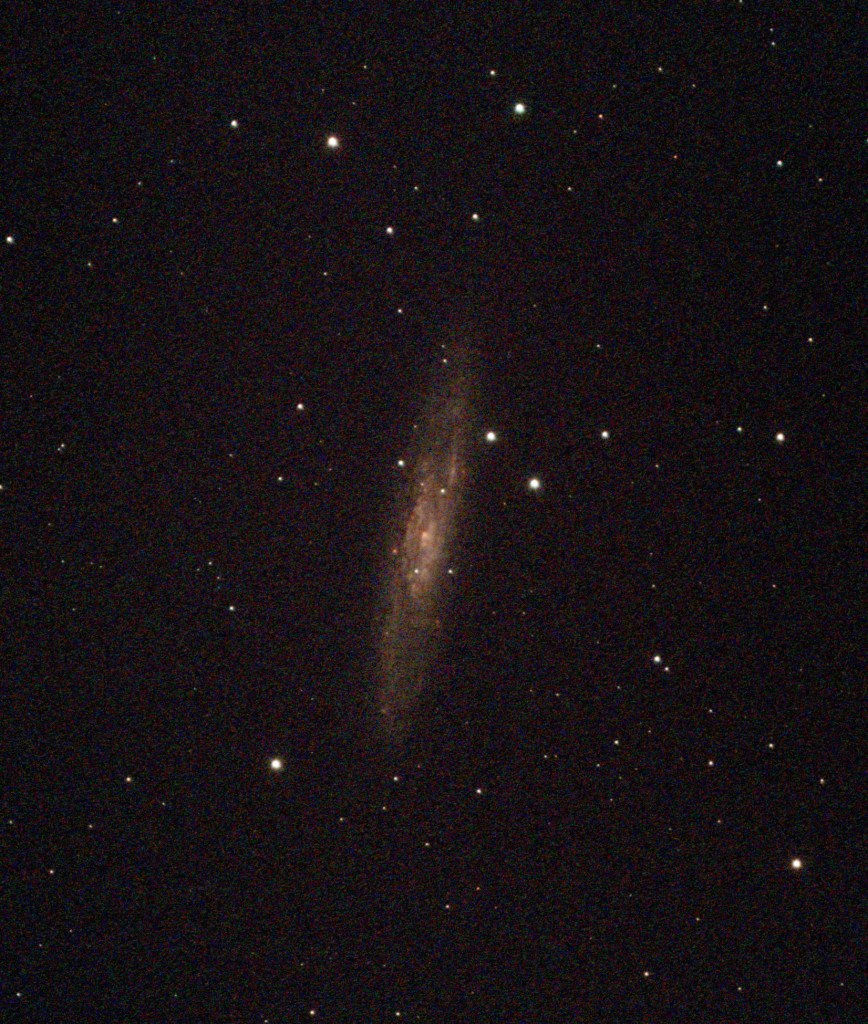


NGC 253, commonly known as the Sculptor Galaxy or Silver Dollar Galaxy, stands as one of the most spectacular and scientifically significant galaxies visible from Earth. Located approximately 11.4 million light-years away in the constellation Sculptor, this intermediate spiral galaxy was discovered by Caroline Herschel on September 23, 1783, during one of her systematic comet searches using a 4.2-inch Newtonian telescope. As the brightest member of the Sculptor Group of galaxies and one of the nearest galaxy groups to our Local Group, NGC 253 holds immense importance in astronomical research due to its proximity and extraordinary activity levels.
The galaxy’s most defining characteristic is its classification as a starburst galaxy, meaning it is currently experiencing an exceptionally intense period of star formation at rates approximately 30 times more efficient than our Milky Way. This vigorous stellar birth has created several massive super star clusters in its central region, including one with a mass of 1.5 million solar masses and another heavily obscured cluster containing a remarkable 14 million solar masses. The starburst activity is believed to have been triggered by a collision with a gas-rich dwarf galaxy approximately 200 million years ago, which disturbed NGC 253’s disk and initiated the current period of intense star formation.
At the heart of this galactic powerhouse lies a supermassive black hole with an estimated mass of about 5 million solar masses. Interestingly, this central black hole remains relatively quiet despite the surrounding stellar chaos, representing an unusual configuration where the black hole “naps amidst stellar chaos”. The galaxy’s starburst activity has also generated powerful galactic winds that expel molecular gas at rates potentially three times faster than new material enters the system, effectively limiting future star formation and representing a process where the galaxy is “causing its own demise”. This phenomenon helps explain why massive galaxies remain relatively rare in the universe, as such outflows deprive would-be stars of the material needed for formation. NGC 253’s combination of proximity, extreme star formation, central supermassive black hole, and self-regulating galactic winds makes it an invaluable laboratory for understanding galaxy evolution, stellar formation processes, and the complex interplay between black holes and their host galaxies.
The original picture took 2.5 hours and 512 exposures (10sec subs). The attached original picture has not been post-processed; however, the other two photos have been enhanced using Adobe Express (although I’m not sure if that made them any better!).
 girish nair